

When school leaders discuss staff wellbeing, the conversation too often defaults to quick fixes: a fruit basket in the staffroom, a termly "wellbeing day," or an afternoon yoga or mindfulness session. While well-intentioned, these perks rarely alleviate the core driver of workplace stress in education—unmanageable daily operational demands.
As highlighted during the Health and Safety Executive (HSE) 2026 Annual General Meeting, regulators and OSH professionals are increasingly recognizing that workplace stress and mental health cannot be treated with reactive, surface-level solutions. Systemic stress requires structured, proactive risk management built directly into the school’s operational rhythm, paired with authentic, practical tools for self-reflection.
Whether you are responding to an Occupational Health recommendation for an individual staff member, addressing feedback from a governor's audit, or aiming to reduce sickness absence across your Multi-Academy Trust, here is a practical guide to embedding meaningful, legally robust wellbeing practices into your school.
1. Spotting Systemic Stress: Timely Staff Surveys
A common trap for leadership teams is issuing staff surveys at the wrong time or asking generic questions that yield unhelpful data. Schools operate on intense cyclical rhythms; avoid sending wellbeing surveys during peak reporting windows, parents' evenings, or mock exam weeks.
• Late Autumn Term (November): Ideal for gauging workload pressures during the longest term and identifying early winter burnout.
• Mid-Spring Term (February/March): A crucial window to measure the impact of new academic year initiatives, SEND support resources, and leadership communication before summer exam/transition pressures build.
Your survey should be quick (5 minutes or less) and target specific operational realities across teaching staff, SLT, and support staff. Structure questions around key themes:
• Work Experience & Support: "I feel supported and listened to by my line manager when things get difficult."
• Leadership & Psychological Safety: "I feel it is safe to challenge the way things are done at our school without fear of negative consequences."
• Targeted Initiatives: "Work emails are restricted to working hours only." or "I am given protected PPA time without routine cover disruptions."
• Classroom & Student Dynamics: "I feel supported by the school’s behaviour policy when managing challenging classroom situations." and "I have adequate time and resources to effectively support pupils with SEND."
Always include open-ended qualitative prompts to capture actionable insights, such as: "If you could change one specific thing about your daily workload to reduce stress, what would it be?"
2. Operationalizing Solutions: The Mental Health Action Plan
A survey is only as good as the action plan that follows it. Rather than creating a standalone strategy document that gathers dust on the school portal, build a Mental Health and Wellbeing Action Plan integrated directly into your termly calendar to translate survey data into practical school operations.
• Clear Communication Channels: Reduce daily cognitive load by publishing cover timetables on the staffroom board every Monday morning, sharing yearly event planners digitally, and keeping weekly calendar changes strictly to daily briefings.
• Dedicated Staff Meeting Time: Schedule at least one staff meeting per half-term dedicated entirely to staff wellbeing. Crucially, involve staff in deciding how this time is used—whether as a collective reflection session or protected personal administration time.
• Environment & Connection: Small changes to physical spaces foster community. Declutter the staffroom, establish a "take a book, leave a book" corner, or introduce a light-hearted "Question of the Day" on the staff board to build social connection.
• Staff Appreciation: Introduce simple, peer-to-peer recognition systems, such as a weekly staff appreciation board where colleagues post brief thank-you notes for mutual support.
3. Gentle Personal Reflection: The "Pitcher & Cups" Energy Metaphor
Wellbeing is a shared responsibility between institutional support and personal empowerment. Beyond formal audits and surveys, individual staff members across all departments benefit from a relaxing, positive reflection framework. Using the 'Pitcher & Cups' energy metaphor, staff can visualize their personal capacity and evaluate what fills their central jug versus what constantly drains it.
When introducing this reflection during dedicated staff meeting time or line management catch-ups, guide staff to explore four gentle questions:
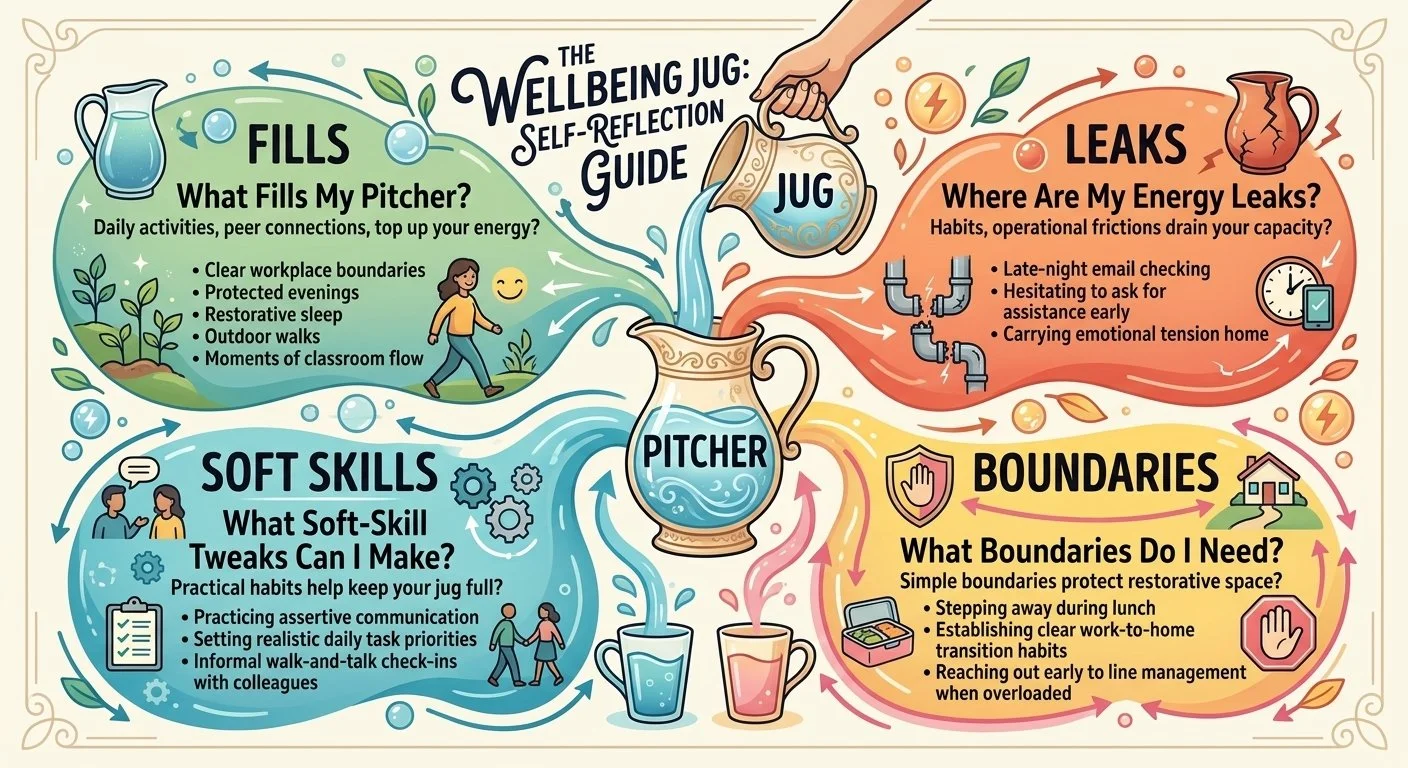
A quick 5-point soft skill self-audit staff can use during individual catch-ups:
• 1. Energy & Boundaries: Am I maintaining healthy boundaries between work responsibilities and my personal downtime?
• 2. Assertive Communication: Do I express concerns, ask for help early, or communicate workload pressures constructively with my line manager?
• 3. Adaptability & Flexibility: How effectively do I adapt to unexpected schedule shifts or sudden operational changes without excessive distress?
• 4. Relational Connection: Do I actively connect with peers, decompress safely, and seek constructive support when feeling isolated?
• 5. Stress Awareness & Resilience: Can I identify early physical or emotional signs of fatigue and take proactive steps to restore energy?
4. Elevating Mental Health: Creative Meeting Spaces
A vital part of any school strategy is providing staff with the tools and permission to reflect on their feelings, build self-awareness, and develop emotional resilience.
Rather than treating self-reflection as an extra task, build it into existing meetings. For example:
• The 5-Minute Meeting Starter: Begin termly twilight or department meetings with 5 minutes of guided self-reflection. Ask staff to reflect individually on: (1) What went well in your job this week? (2) What situation caused heightened frustration or anxiety, and how did I react? (3) What is one boundary I can set this week to protect my personal energy?
• Learning from Workplace Dynamics: Normalising open discussions about emotional workplace triggers helps staff recognize early signs of stress before they manifest as physical exhaustion or anxiety.
Who says staff meetings must take place in a sterile hall or cramped staffroom? Changing the physical environment dramatically alters the dynamic of conversation, breaks down hierarchy, and reduces tension.
• Outdoor Twilights: Hold a termly twilight meeting outdoors. One headteacher recently transformed a routine afternoon session by holding an outdoor twilight in the EYFS playground. Staff played music, chatted informally about their work, and completed a light, collaborative tidying of the outdoor learning area. The combination of fresh air, physical movement, informal conversation, and a shared practical goal left staff feeling energized rather than drained.
• Walk-and-Talk One-to-Ones: Conduct line management check-ins or mentoring catch-ups while walking around the school grounds or local nature paths rather than sitting across a desk.
5. Formal Individual Risk Assessments (HSE Standards)
While whole-school surveys, action plans, and gentle reflection tools address proactive, cultural wellbeing, formal individual support remains essential. When a School Business Manager or Headteacher receives an Occupational Health referral or manages an individual returning from work-related absence, a structured Individual Stress Risk Assessment should be conducted using the 6 HSE Management Standards (Demands, Control, Support, Relationships, Role, and Change) to establish specific, agreed-upon workplace adjustments.
Summary Checklist for School Leaders
• 1. Spot systemic stress early: Capture school-wide workload trends and sentiment using short, targeted surveys during quiet operational windows.
• 2. Operationalise action plans: Translate survey findings into a termly Action Plan featuring clear communication channels and dedicated wellbeing meeting time.
• 3. Foster gentle reflection: Use the Pitcher & Cups energy metaphor and soft-skill reflection prompts to help staff manage personal energy and set boundaries.
• 4. Change the scenery: Break the routine by taking staff meetings outdoors or integrating physical walk-and-talk sessions.
• 5. Support individual statutory needs: Use formal 1-to-1 HSE stress risk assessments when managing Occupational Health referrals or return-to-work cases.
By shifting the focus from superficial perks to meaningful operational adjustments and reflective practices, school leaders can create a healthy, resilient workplace culture where staff feel genuinely supported, valued, and empowered to succeed.
Need assistance tailoring an Individual Stress Risk Assessment framework or building an HSE-aligned Wellbeing Action Plan for your school? Contact Health and Safety in Care (HSinCare) today.